
How Home Care Helps for Elders with Cognitive and Mobility Limitations
| Did you know, as per the American Psychological Association, in the USA, 22% of elders have mild cognitive impairment and mobility disability. Well, it is one of the most common limitations among older adults. |
In such scenarios, when an elder is living with memory loss, confusion, poor balance, weakness, or limited movement, even simple daily tasks can become stressful and unsafe. Here, home care helps by bringing patient, one-on-one support into the place they know best: their own home. This also helps them regain their sense of independence, dignity, and emotional security.
Now, if you are looking to see whether you need these services, this blog is for you. Here, we explain exactly how home care supports elders, why it matters to families, and how the right care can make everyday life safer and more manageable, so that you can make the right choice. Let’s begin!
Care at Home Overview
Home care supports older adults experiencing cognitive and mobility challenges by providing structured assistance with activities of daily living, safety supervision, and routine management. It helps maintain medication consistency, encourages mental engagement, ensures safer home environments, and offers mobility support to reduce fall risks. Caregivers also address emotional well-being through companionship and structured interaction. By balancing assistance with independence, home care enables seniors to live comfortably, safely, and confidently at home with personalized attention to their changing physical and cognitive needs.
Understanding Cognitive and Mobility Limitations in Elders
Cognitive and mobility limitations often develop over time due to neurological changes, chronic illness, or natural aging. These restrictions significantly affect how seniors interact with their surroundings and perform tasks.
Cognitive Limitations
These changes can be associated with aging, medical conditions, side effects, or even difficulty with hearing and vision. These changes are not the same for everyone, and some people may experience only minor issues with thinking problems, which can affect their ability to live independently, including conditions like dementia.
| Among U.S. adults aged 85 years and older, 37.3% have four or more chronic health conditions, according to the CDC National Health Interview Survey (2024 data, published 2026). This level of multimorbidity highlights a significant increase in health complexity with age, contributing to reduced independence, greater care needs, and greater functional and cognitive vulnerability in older populations. |
Important functions and consequences include:
- Having trouble performing complex procedures or activities like taking medications
- Short-term memory loss
- Lack of judgment or wisdom in home safety issues.
- Delay in the processing of information in communication
Mobility Limitations
A decrease in physical control, stability, and movement efficiency is a mobility restriction. This has been linked to loss of muscle strength, neurological damage, or musculoskeletal degeneration.
Functional impacts include:
- Difficulty maintaining balance while standing or walking
- Trouble getting up from or sitting down on chairs
- Reduced stamina for walking or moving around for daily tasks
- Feeling shaky or unsure when turning or changing direction
The environment needs to be modified, and physical assistance may be necessary to ensure safe mobility within the home.
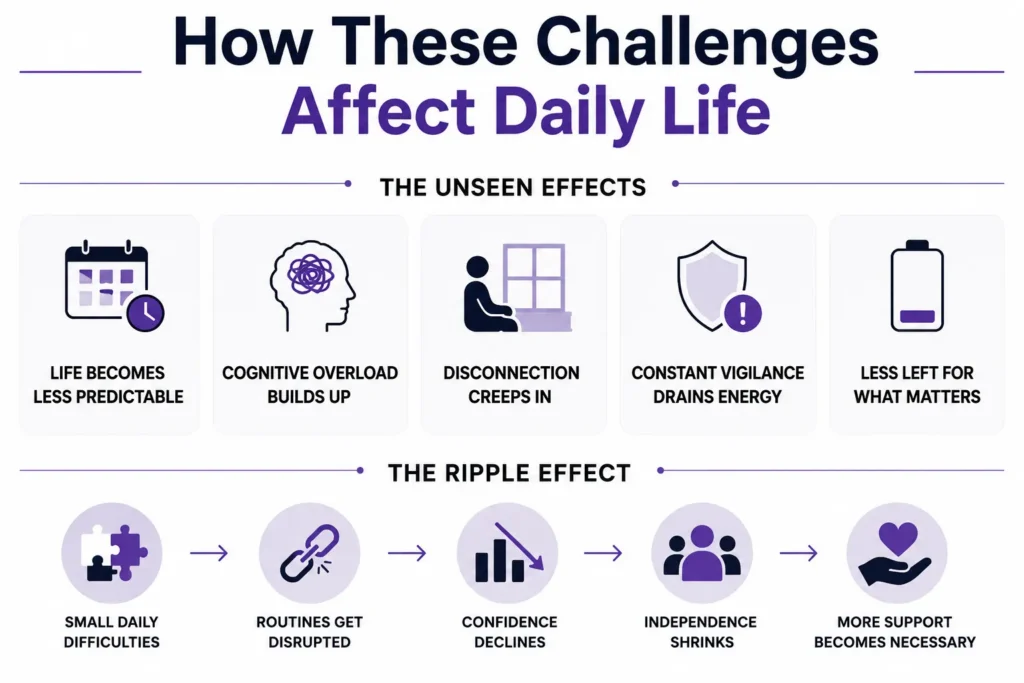
How do these challenges affect daily life?
Daily routines and independence can become increasingly difficult to manage, ultimately affecting confidence and overall quality of life.
How Home Care Services Can Help With Cognitive and Mobility Limitations?
Home care services help with cognitive and mobility issues by providing structured support that reduces risk, enhances function, and promotes stability in daily living. Here are various services and how they help:
Medication and Health Reminders
Medication accuracy and adherence to timing are often affected by cognitive decline. Home caregivers implement a structured reminder system, which maintains consistency in:
- Prescription schedules
- Dosage accuracy
- Timing hydration and nutrition
- Appointment tracking
This helps minimize the clinical risks of missed and incorrect doses and enhances treatment continuity.
Encouraging Mental Stimulation
Cognitive engagement is maintained through guided interaction techniques, which stimulate memory and attention pathways. Caregivers may support:
- Conversational recall exercises
- Routine-based cognitive reinforcement
- Mental health activities that involve thinking about tasks
- Step-by-step support for completing daily tasks in an organized way
These interventions help a person remain cognitively responsive without being overworked.
Creating a Safe and Familiar Environment
Maintaining a stable and familiar home environment helps reduce confusion and lowers the risk of accidents for older adults. Home care support in this area includes:
- Ensuring walkways are clear to prevent tripping hazards.
- Arranging things in a familiar and convenient location
- Improving lighting to support better visibility and orientation
- Using labels or signs to facilitate easy room or item identification for seniors
- A predictable environment reduces cognitive strain and supports safer navigation.
Mobility Support and Fall Prevention
Mobility assistance for seniors is about keeping the person safe and reducing stress on their body and the likelihood of injury. Caregivers provide:
- Guidance and physical support while moving around the home
- Use of a mobility aid, such as a walker or a cane, correctly
- Support when bathing and using the toilet to avoid slipping.
- Monitoring balance to identify early signs of instability
Structured support will minimize the risk of falls and build confidence in physical mobility.
Reducing Isolation and Emotional Distress
Limited mobility and cognitive function can contribute to limited social interaction. Home care alleviates this by regular contact and planned interaction, such as:
- Daily conversational support
- Support and reassurance
- Being involved in light recreational activities
Maintaining Independence at Home
A key objective of home care is to preserve functional independence within safe boundaries. This is achieved by:
- Supporting tasks rather than replacing them entirely
- Providing just the right amount of help based on what the person can do safely and comfortably
- Reinforcing familiar routines to maintain autonomy
This approach ensures seniors remain actively involved in their own care process.
Conclusion
In-home support is essential for helping seniors stay safe, comfortable, and independent in their everyday activities and health issues. Now, if you are looking for a reliable partner to support you in this, Family Ties Homecare provides personal and professional care services in the home, customized to improve quality of life and ensure a family member is cared for every day in a compassionate, reliable, and attentive manner.
Bring comfort, dignity, and peace of mind into your home today because your loved ones deserve care that feels like family.
FAQs
1. When is home care an option for the elderly relative?
The need for assistance with activities and for maintaining safety begins to arise, and with this constant need for assistance with mobility and health care, home care should be considered.
2. What are the skills a home care worker typically needs?
Elderly care can be provided through a certificate course in elderly care or nursing care, or through specialized training to care for those with medical and cognitive issues.
3. Is home care provided, and if so, are they for a few hours a day or full-time?
Home care is individual, and can be offered a few hours per day, overnight, or every day.
4. How is the caregiver fit for the senior assessed?
Providers find the appropriate child care worker to provide comfort and trust. Providers usually match carers based on personality and language.
5. If a senior is able to refuse the care but requires assistance for safety reasons, what should happen?
Caregivers employ gradual engagement strategies, respect for communication, and routine-based support to encourage cooperation without stress or resistance.
